
The decline in emissions in 2026 is primarily a consequence of the reduction in oil and gas supply due to the conflicts in Iran and Ukraine, but builds on trends that were already causing emissions growth to slow down. Photo: Evgeny Tkachev, iStock
Global fossil co₂ emissions set to unexpectedly decrease in 2026
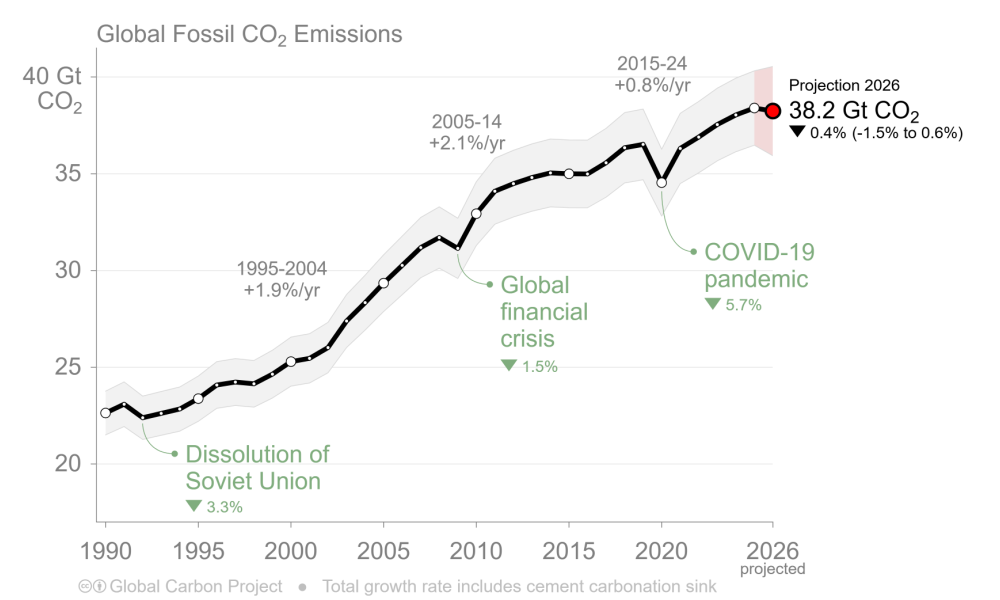
Global fossil co₂ emissions are set to decrease 0.4% in 2026 as the energy shock driven by the closure of the Strait of Hormuz reduces oil and gas use. Clean energy growth continues but remains insufficient for a structural peak and decline in emissions.


On the 10th of November, the Global Carbon Project (GCP) publishes its 21st annual analysis of trends in the global carbon cycle in the journal Earth System Science Data Discussions1, together with an article in Nature Climate Change on the mechanisms needed for a peak in global fossil CO2 emissions.
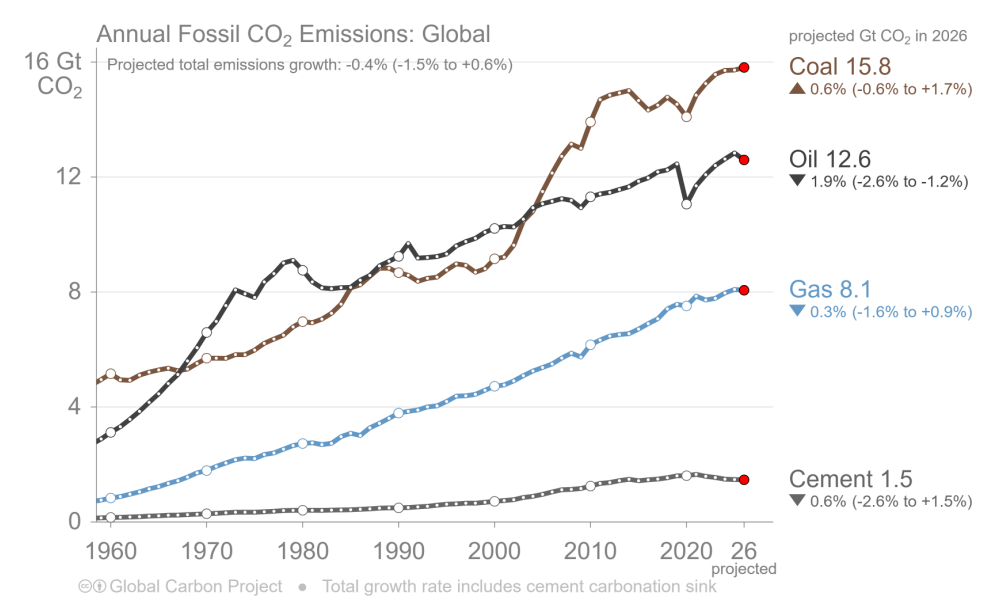
Global fossil CO2 emissions2 are expected to decline 0.4% in 2026 (with an uncertainty3 range of -1.5% to 0.6%). This decline was unexpected at the start of the year. The decline is primarily a consequence of the reduction in oil and gas supply due to the conflicts in Iran and Ukraine, but builds on trends that were already causing emissions growth to slow down.
“A drop in emissions in one year is not a peak unless it is driven by structural change,” said Glen Peters, a Research Professor at the CICERO Center for International Climate Research. “Accelerated deployment of solar, wind, batteries, and electric vehicles are pushing emissions down in dozens of countries, and slowing emissions growth in many more, but the changes are not yet sufficient to lock in a peak and decline in global emissions”.
The response to the current crisis could cause a more lasting reduction in emissions growth than after COVID or the Global Financial Crisis. The crisis this time is driven by a shock to oil supplies themselves and not financial markets, a virus or other factors unrelated to energy or emissions.
A drop in emissions in one year is not a peak unless it is driven by structural change.
Fossil co₂ emissions drop in China, USA, and the European Union
Fossil CO2 emissions had a statistically significant decrease in 40 countries while their economies grew, and these countries represented 26% of global fossil CO2 emissions during the past decade (2016-2025). During the previous decade 2006-2015, only 22 countries had statistically significant decreases in emissions.
In China (32% of global emissions), emissions in 2026 are projected to decline 0.9% [–2.6% to 0.8%], following two years of low growth. A significant drop in oil use and a smaller decline in natural gas consumption was tempered by a slight percentagewise increase4 in coal use, although zero growth or a small decrease in coal are well within the uncertainty margins.
There has been much discussion on whether Chinese fossil CO2 emissions have peaked. A drop of emissions in one year does not imply a peak and permanent decline, but emissions have now grown little or not at all for three years in a row.
“Total oil consumption may have fallen by more than 5%, and oil use in transportation was already projected to reach a peak this year or next thanks mostly to electrification and slower growth,” said Jan Ivar Korsbakken, Senior Researcher at CICERO, who makes the projections for Chinese emissions. “Coal consumption may have grown slightly due to growing electricity demand, but the increase is small and the uncertainty high enough that it may well have declined. Either way, solar, wind and other non-fossil sources covered most of the demand growth”. He cautions: “But, the Chinese economy has been in a slump for several years. After previous slowdowns, renewed growth has often come from energy- and emission-intensive sectors. There are good reasons to think this time is different, but it is still too early to say whether Chinese CO2 emissions have finally peaked.”
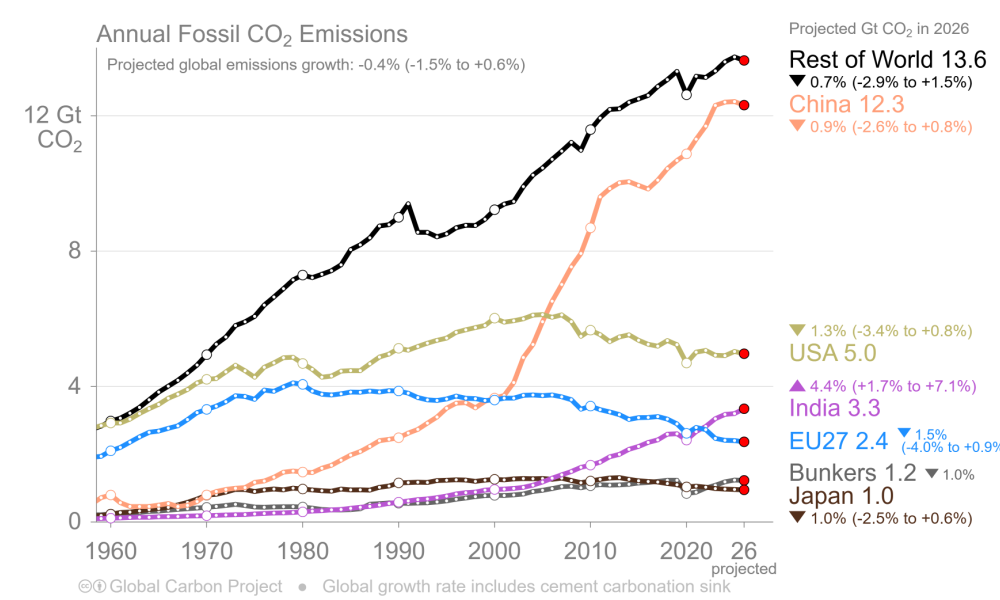
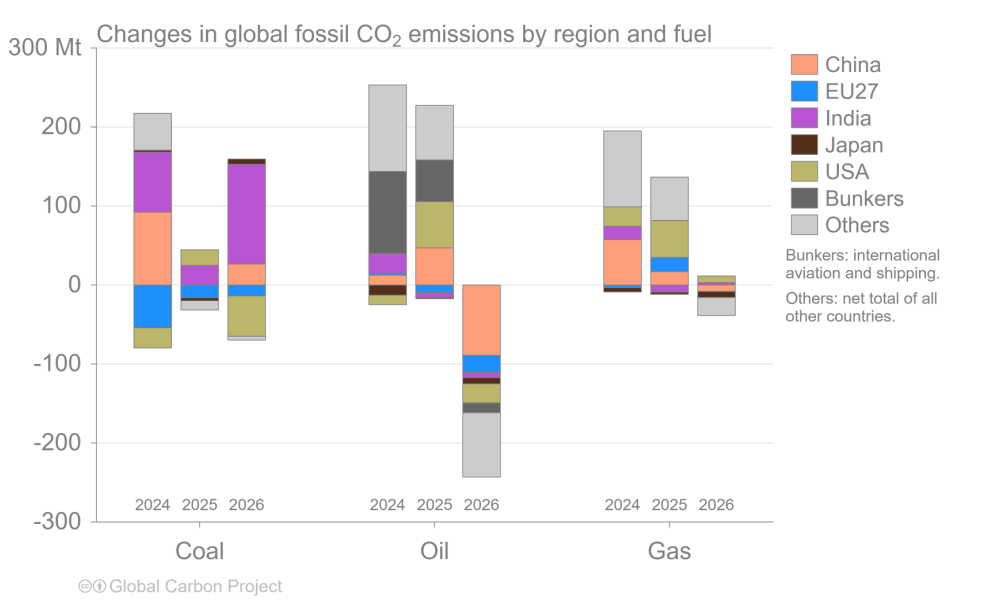
In the United States (13% of global emissions), emissions in 2026 are projected to decrease by 1.3% [–3.4% to 0.8%]. Coal emissions continue their long-term decline, with a small increase in gas, but a drop in oil indicating that the US was not immune to the Iranian conflict.
“US emissions are still trending down, although 2025 was an exception because of a colder winter and raised natural gas prices. But in 2026 we see a reversion to trend. Despite federal policy, there is still strong growth in renewables and batteries,” said Robbie Andrew, Senior Researcher at CICERO.
In India (8% of global emissions), emissions in 2026 are projected to increase by 4.4% [1.7% to 7.1%], well above the 3.5% average annual growth over the last decade. The increase is driven by a rapid increase in emissions from coal use of 5.9%, tempered by a decline in emissions from oil use.
“Part of the reason for the larger growth this year in India is simply the weather: a relatively dry monsoon meant higher temperatures and more demand for cooling, and last year was a relatively wet monsoon,” said Andrew.
In the European Union (6% of global emissions), emissions in 2026 are projected to decline 1.5% [–2.1% to 0.9%], with reductions in coal, oil, gas, and cement.
“Emissions in the EU have been declining for some time, driven partly by strong policies. The decline in nuclear generation has made the job harder, but renewables are growing strongly,” said Andrew.
In Japan (2.5% of global emissions), with projections based on a newly published monthly emissions dataset, emissions in 2026 are projected to decrease by 1.0% [–2.5% to +0.6%], continuing its long-term downwards trend.
“Japan is a case where gas emissions decreased substantially due to the conflict in the Middle East. On the other hand, coal emissions have increased somewhat to compensate for the decline in gas usage”, said Taro Kunimitsu, Senior Researcher at CICERO, working on the projections for Japan.
Emissions are also projected to decrease by 1% for international aviation (1.5% of global emissions) and 1% for international shipping (1.7% of global emissions).
“The change in international aviation is quite large, given that the projected 1% decrease in emissions should be compared to 5% growth forecast by the industry at the start of the year,” said Andrew. “The conflict in the Middle East has had an impact on aviation, but this impact won’t be long-lived.”
The Rest of the World in aggregate (38% of global emissions) emissions are projected to decrease in 2026 by 0.7% [–2.9% to +1.5%]. The largest component of the decline is in oil, driven global supply constraints that have led to surging prices.
co₂ emissions from land-use change lower in the past decade
Global net CO2 emissions from land-use change (LUC5) averaged 4.9 Gtco₂ per year for the past decade (2016-2025) with a slight increase expected in 2026. In the last decade, LUC emissions have trended downwards.
Total CO2 emissions (fossil plus LUC) grew 0.3% per year in the last decade (2016-2025), compared to 1.7% in the previous decade (2006-2015). The rise in fossil CO2 emissions is compensated by the decline in land-use change co₂ emissions.
Total CO2 emissions were 42.8 Gtco₂ in 2025, with a slightly higher estimate of 43.3 Gtco₂ in 2026, with large uncertainty precluding additional interpretation.
Atmospheric co₂ is estimated to have a small increase, with El Niño effects expected in 2027
The last two years have seen relatively modest increases in atmospheric CO2 concentrations, expected to increase 2.2 parts per million in 2026 after increasing 2.1 parts per million in 2025. These increases are lower than the record increase of 3.7 parts per million in 2024 and the average increase of 2.5 parts per million per year in the last decade.
The concentration of CO2 in the atmosphere is set to reach 428 ppm in 2026, 53% above preindustrial levels.
El Niño6 events have a significant impact on the carbon cycle. We are just recovering from a significant El Niño event three years ago, but a record El Niño is building throughout 2026.
“A huge El Niño is building, but its impact on the carbon cycle comes with a delay, leading to an expectation of big atmospheric increase and weak land sink in 2027,” said Glen Peters.
A huge El Niño is building, but its impact on the carbon cycle comes with a delay, leading to an expectation of big atmospheric increase and weak land sink in 2027.
Land and ocean sink
The land and ocean have taken up 22% and 27% of total CO2 emissions in the past decade, respectively.
The land sink weakened substantially in 2024 due to El Niño conditions but returned fully in 2025 to its pre-El Niño level. Preliminary estimates indicate a further strengthening of the land sink over 2026.
“It is reassuring to see that the land sink is recovering from the previous El Niño”, says Kjetil Aas, Senior Researcher at CICERO. “However, it remains to be seen what the long-term effect will be of two strong El Niños on top of the general warming, which is already putting pressure on especially tropical ecosystems.”
....................................................................................................................................................
Footnotes
1 The article is submitted as a discussion paper in open peer review to ensure broad community input.
2 The global fossil CO2 emissions include CO2 emissions from the burning of coal, oil, and gas, and in chemical processes such as the production of cement. The global total also includes the small uptake from cement carbonation.
3 The 2026 emissions projection is based on the use of monthly energy data, with the latest data between August and October, and we then make judgements about how emissions may develop for the remainder of the year.
4 Due to China’s vast size, even a fraction of a percent can still equate to tens of millions of tonnes of both coal and resulting CO2 emissions.
5 Net CO2 emissions from land-use change refer to emissions, but also removals, from activities such as deforestation, re/afforestation, and wood harvest and regrowth.
6 El Niño is the warm phase of a natural climate cycle in the tropical Pacific Ocean, characterized by unusually warm sea surface temperatures that influence weather patterns around the world.
Check out our podcast Climate Sensitivity's episode on the global carbon budget 2026
Related research groups
References
-
Friedlingstein et al. (2026) Global Carbon Budget 2026. Earth System Science Data Discussion (preprint available after embargo)
-
Le Quéré et al. (2026) A further acceleration of clean energy is needed for global co₂ emissions to peak and decline. Nature Climate Change (available after embargo)
-
Kunimitsu and Andrew (2026), Monthly-updated territorial fossil co₂ emissions estimates for Japan, Earth System Science Data Discussion, https://essd.copernicus.org/articles/18/8003/2026/